Huawei Routers: The Complete NetEngine Range for Enterprise WAN & Branch Networking
Every branch office, every WAN link, and every SD-WAN rollout eventually comes down to one device making the routing decision — and for a growing number of enterprises across the UAE, Saudi Arabia, the wider GCC, and Africa, that device is a Huawei router.
Huawei’s enterprise routing lineup — branded NetEngine — spans everything from compact branch office routers handling a single internet connection to carrier-grade core routers moving terabits of traffic across national and regional networks. What ties the range together is Huawei’s consistent focus on SD-WAN readiness, intelligent traffic management, and the same underlying VRP operating system across most of the portfolio.
Netseg supplies the full range of Huawei enterprise routers, from NetEngine AR6100 branch routers for a small office to NetEngine 8000 and 40E-class core routers for large WAN backbones and service provider networks. Whether you’re connecting a single branch, rolling out SD-WAN across dozens of sites, or refreshing a WAN core, this page walks through exactly which model fits your environment — and why Huawei keeps appearing on shortlists for organizations balancing performance, automation, and cost.
Why source Huawei routers through Netseg:
- Genuine, factory-sealed Huawei NetEngine hardware with full manufacturer warranty
- Competitive, transparent pricing for single units and enterprise-wide rollouts
- Same-day quotations for standard configurations
- Regional logistics across the UAE, Saudi Arabia, GCC, and Africa, plus worldwide shipping
- Pre-sales design support from engineers who understand SD-WAN and WAN architecture, not just a spec sheet
- After-sales technical support, not just an invoice
If you already know which model you need, jump to our product comparison table. If you’re still deciding, the buying guide further down will walk you through it step by step.
What Are Huawei Routers?
Huawei routers are enterprise-grade networking devices that connect branch offices, campuses, and data centers to the wider internet or private WAN, handling everything from basic internet gateway duties to complex SD-WAN, MPLS, and carrier-grade core routing.
The core segments of Huawei’s enterprise routing portfolio:
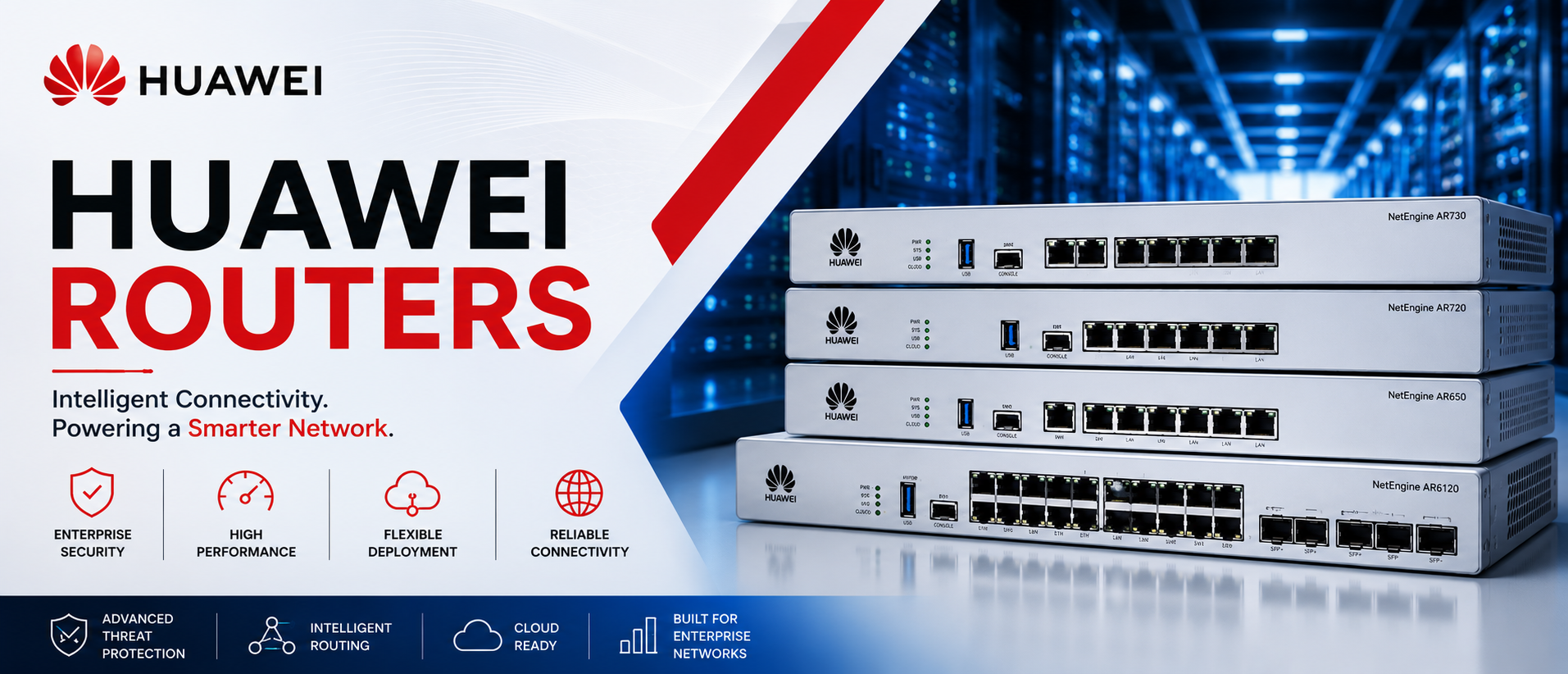
- Branch and campus routing — the NetEngine AR Series (AR6100, AR6700, AR8000, AR8700), positioned as WAN egress and SD-WAN edge devices for small offices through large campus headquarters
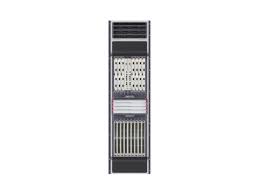
- Enterprise WAN and carrier-grade core routing — the NetEngine 8000 Series and NetEngine 40E Series, built for WAN cores, data center interconnect, aggregation, and large-scale backbone routing
- SD-WAN — software-defined WAN capability built into the AR Series, letting organizations manage multiple WAN links (broadband, MPLS, LTE/5G) as a single, intelligently steered connection
- VRP Operating System — Huawei’s Versatile Routing Platform, the operating system underpinning the vast majority of Huawei’s enterprise networking hardware, providing a consistent command structure and feature set across the range
- AI-powered networking — Huawei’s broader push toward intent-driven automation, using its Network Cloud Engine (NCE) management platform to simplify configuration, monitoring, and lifecycle operations across large deployments
In practice, most enterprise buyers land in one of two categories: organizations needing an SD-WAN-capable branch or campus egress router (AR Series), and organizations needing high-throughput core or aggregation routing for a WAN backbone or data center interconnect (NetEngine 8000/40E Series).
Why Businesses Choose Huawei Routers?
Huawei’s enterprise routing division has grown a loyal following across the region for a consistent set of reasons.
Performance built for real WAN traffic. From branch-level throughput to multi-terabit core routing capacity on the largest NetEngine 40E chassis, Huawei’s portfolio scales without forcing a platform change every time bandwidth requirements grow.
Reliability engineers can plan around. Redundant power supplies, redundant switching/routing fabric on higher-end models, and non-blocking switching architectures are standard design elements across most of the range, not premium add-ons.
Security built into the routing layer. IPsec VPN, ACLs, NAT, and application-aware traffic policies let IT teams enforce segmentation and secure connectivity at the WAN edge — a genuine requirement for banks, government entities, and healthcare providers in this region.
Scalability across the full WAN. A single vendor and largely consistent operating system (VRP) can span the smallest branch router and the largest core router, simplifying operational knowledge requirements for network teams managing a mixed environment.
Strong SD-WAN capabilities. Huawei’s AR Series routers were built with SD-WAN as a core use case from the start, with the AR6700 and AR8000 lines specifically marketed as purpose-built SD-WAN edge devices — supporting intelligent path selection across broadband, MPLS, and LTE/5G links.
Intelligent, automated routing. Application-aware traffic steering and quality-of-service policies let organizations prioritize business-critical traffic automatically rather than relying purely on static routing decisions.
High availability where it matters. Dual power supplies, hardware redundancy, and hot-swappable components on the larger NetEngine 8000/40E platforms support the uptime requirements of finance, telecom, and government backbone deployments.
Lower total cost of ownership. Huawei’s routing hardware is frequently positioned as delivering strong performance-per-dollar relative to established Western vendors, which matters for procurement teams balancing capability against budget across large, multi-site rollouts.
Key Features Explained
NetEngine Architecture
“NetEngine” is Huawei’s umbrella brand for its enterprise and carrier routing hardware, spanning the AR Series (branch/campus/SD-WAN) through the 8000 and 40E Series (core, aggregation, and data center interconnect). The branding reflects a design philosophy shared across the range: multi-core processing, non-blocking switching, and a consistent software foundation.
VRP Operating System
VRP (Versatile Routing Platform) is Huawei’s proprietary network operating system, running across the vast majority of its enterprise routers and switches. A network engineer who learns VRP on a branch-level AR router can apply much of that same knowledge to a much larger NetEngine 8000 core router — a genuine efficiency for IT teams standardizing on Huawei across their WAN.
SD-WAN
Software-Defined WAN lets an organization treat multiple WAN connections — broadband internet, MPLS, LTE, 5G — as a single logical, intelligently managed link, with traffic steered dynamically based on application requirements, link quality, and cost. Huawei’s AR6700 and AR8000 Series were specifically built as SD-WAN-ready edge devices, positioned for exactly this use case at small-to-large campus egress points.
VPN and IPsec
Virtual Private Network capability, commonly implemented via IPsec, lets branch offices establish encrypted tunnels back to headquarters or between sites over the public internet, avoiding the cost of dedicated private circuits while maintaining data confidentiality.
MPLS
Multiprotocol Label Switching remains widely used for enterprise WAN connectivity, particularly where predictable performance and traffic engineering matter more than internet-based SD-WAN flexibility. Huawei’s routing portfolio supports MPLS alongside SD-WAN, letting organizations run hybrid WAN designs that combine both approaches.
BGP, OSPF, RIP, and IS-IS
Huawei’s routers support the full standard suite of routing protocols: BGP for large-scale, policy-driven routing (common at WAN edges and core routers), OSPF for enterprise and campus interior routing, RIP for simpler legacy scenarios, and IS-IS, widely used in large-scale service provider and carrier backbone deployments.
QoS
Quality of Service lets network teams prioritize latency-sensitive traffic — voice, video conferencing, and increasingly cloud application traffic — ahead of best-effort data, which matters considerably more on WAN links than on local campus networks where bandwidth is comparatively abundant.
ACL
Access Control Lists provide granular, rule-based traffic filtering at the router, letting administrators enforce segmentation and security policy at the WAN edge in addition to whatever firewall sits alongside it.
NAT
Network Address Translation remains a foundational function for any internet-facing router, allowing internal, privately addressed networks to communicate with the public internet through a shared, translated address.
IPv4 and IPv6
Full dual-stack IPv4/IPv6 support is standard across Huawei’s current enterprise router range, an increasingly relevant requirement for government and telecom deployments in the region where IPv6 adoption timelines continue to firm up.
LTE and 5G Connectivity
Many AR Series branch routers support LTE (and increasingly 5G) as either a primary or backup WAN connection, which matters significantly for retail, hospitality, and remote-site deployments where fixed-line connectivity is unreliable or where a fast failover path is a business requirement.
Zero Touch Provisioning
New Huawei routers can be shipped directly to a remote branch site and automatically pull their configuration from a central management platform once powered on and connected — a major operational advantage for multi-site retail and hospitality rollouts where no local IT staff is available to configure the device manually.
Cloud Management and Network Automation
Huawei’s Network Cloud Engine (NCE) platform provides centralized, cloud-based configuration, monitoring, and lifecycle management across a fleet of routers, and increasingly incorporates intent-driven automation — letting network teams define a desired outcome and have the platform handle the underlying configuration, rather than configuring every device manually.
High Availability and Redundant Power
Dual, hot-swappable power supplies and redundant switching fabric (on larger NetEngine 8000/40E chassis) reduce single points of failure — a requirement for financial institutions, telecom operators, and government backbone deployments that cannot tolerate WAN downtime.
Intelligent Traffic Management
Application-aware traffic identification lets Huawei routers recognize specific application types (voice, video, cloud SaaS traffic) and apply differentiated routing and QoS policies automatically — a meaningful step beyond static, port-based traffic classification.
Huawei Router Product Families
Huawei’s enterprise routing range splits cleanly into branch/campus SD-WAN routers (the AR Series) and WAN core/aggregation routers (the NetEngine 8000 and 40E Series).
| Model | Best For | Deployment Type | WAN Performance | Security | SD-WAN Support | VPN | Ideal Business Size |
|---|---|---|---|---|---|---|---|
| NetEngine AR6100 | Small offices, SME headquarters and branches | Branch/Campus Egress | Entry-level WAN throughput | ACL, NAT, basic firewall | Basic | IPsec VPN | Small business (SME) |
| NetEngine AR6700 | Medium/small campus egress, enterprise headquarters | Branch/Campus Egress | High-performance SD-WAN throughput (multi-core, non-blocking architecture) | ACL, NAT, IPsec, application awareness | Full SD-WAN (purpose-built) | IPsec VPN | SMB to mid-market |
| NetEngine AR8000 | Large campus egress, multi-site enterprise SD-WAN | Branch/Campus Egress | High-performance SD-WAN throughput, high AP-management capacity | ACL, NAT, IPsec, application awareness | Full SD-WAN (purpose-built) | IPsec VPN | Mid-market to enterprise |
| NetEngine AR8700 | Large campus and enterprise headquarters SD-WAN egress | Branch/Campus Egress | High-performance SD-WAN throughput, large-scale AP support | ACL, NAT, IPsec, application awareness | Full SD-WAN (purpose-built) | IPsec VPN | Enterprise |
| NetEngine 8000 Series | WAN core, aggregation, data center interconnect, campus/IDC egress | Core/Aggregation | Very high capacity (multi-terabit class on larger chassis) | ACL, VPN, segment routing security | Supports SD-WAN-integrated WAN designs | L2VPN/L3VPN, MPLS-based VPN | Large enterprise / service provider |
| NetEngine 40E Series | High-end WAN backbone, IP metro networks, carrier-grade core | Core | Industry-leading routing capacity (multi-terabit, high-slot-density chassis) | ACL, VPN, IPsec tunneling, RADIUS/TACACS+ | Supports SD-WAN-integrated WAN designs | L2VPN/L3VPN, MPLS-based VPN, GRE | Large enterprise / telecom / service provider |
Quick read on the table: if you’re connecting an office, branch, or campus to the internet or a WAN — with or without SD-WAN — you’re in AR Series territory (AR6100 for small sites, scaling up through AR6700/AR8000/AR8700 as size and SD-WAN sophistication increase). If you’re building or refreshing a WAN core, aggregation layer, or data center interconnect, you’re looking at the NetEngine 8000 or 40E Series.
Industries That Use Huawei Routers
Huawei’s enterprise routing portfolio is deployed widely across the UAE, Saudi Arabia, and wider GCC/Africa markets:
- Government — secure, SD-WAN-enabled connectivity between government offices and data centers, with strong VPN and segmentation capability
- Healthcare — reliable branch and campus WAN connectivity supporting telemedicine, imaging transfer, and clinical system access across multiple facilities
- Education — cost-effective campus egress routing for schools and universities managing multi-building or multi-campus connectivity
- Banking & Financial Institutions — high-availability, VPN-secured WAN connectivity between branches and data centers, often layered with MPLS for predictable performance
- Hospitality — SD-WAN-capable branch routers with LTE/5G backup connectivity for hotel properties needing resilient, centrally managed WAN links
- Manufacturing — reliable branch and site-to-site connectivity supporting OT/IT convergence and centralized ERP/MES system access
- Retail — multi-site SD-WAN deployments standardized on Zero Touch Provisioning for fast store rollouts and centralized management
- Warehousing — resilient WAN connectivity supporting centralized inventory and logistics systems across distributed sites
- Telecommunications — NetEngine 8000/40E-class core and aggregation routing for carrier backbone and IP metro networks
- Oil & Gas — high-availability, secure WAN connectivity for control rooms and remote facility networking, often with LTE/5G backup
- Data Centers — NetEngine 8000-class routers for data center interconnect (DCI) and edge routing roles
- Enterprise Branch Offices — the most common overall use case: AR Series SD-WAN routers connecting distributed branch locations back to headquarters and cloud applications
Huawei Routers vs Cisco Routers
Cisco remains the established incumbent in many regional WAN deployments, so this comparison comes up frequently.
| Factor | Huawei NetEngine | Cisco ISR/ASR/Catalyst |
|---|---|---|
| Performance | Strong across branch and core tiers; NetEngine 40E offers industry-leading routing capacity on its largest chassis | Broad, mature portfolio with strong performance across a wide range of use cases |
| SD-WAN | Purpose-built SD-WAN edge devices (AR6700/AR8000/AR8700) with application-aware traffic steering | Cisco SD-WAN (Catalyst SD-WAN, formerly Viptela) is a mature, widely deployed platform with deep third-party ecosystem integration |
| Security | ACL, IPsec VPN, NAT, and application awareness built in; less of a dedicated security ecosystem than Cisco’s | Extensive security ecosystem (Umbrella, Talos threat intelligence, integrated firewall options), often at additional licensing cost |
| Automation | Network Cloud Engine (NCE) provides centralized, increasingly intent-driven automation | DNA Center/Catalyst Center and Cisco SD-WAN vManage offer polished, well-established automation, typically at additional licensing cost |
| Routing Features | Full support for BGP, OSPF, IS-IS, MPLS, SRv6; strong core routing pedigree at the carrier tier | Full routing feature parity; long, proven track record particularly in complex enterprise and service provider deployments |
| Cloud Management | NCE-based cloud and centralized management | Cisco Meraki and Catalyst Center offer polished cloud management, a genuine strength for distributed branch environments |
| Scalability | Scales from small branch to carrier-grade core; strong presence in telecom/service provider core routing | Scales extensively, with a long track record across enterprise and service provider deployments |
| Total Cost of Ownership | Frequently positioned as delivering strong performance-per-dollar | Often higher due to licensing tiers, particularly for SD-WAN and integrated security features |
Bottom line: Cisco’s ecosystem depth — particularly its security integrations and long enterprise track record — is real, and organizations already standardized on Cisco SD-WAN or security tooling may find switching costly. For organizations prioritizing strong SD-WAN performance and lower total cost of ownership without sacrificing core routing capability, Huawei is an increasingly common and credible alternative in this region.
Huawei Routers vs Juniper Routers
Juniper is well regarded for its Junos operating system and strong service-provider routing heritage.
- Performance: Both vendors compete closely at the carrier and WAN core tier; Juniper’s MX Series and Huawei’s NetEngine 8000/40E Series both target high-capacity core and edge routing roles with comparable throughput classes.
- Routing Features: Juniper’s Junos has a long-standing reputation for routing protocol depth and stability in service provider networks; Huawei’s VRP-based NetEngine platform offers comparable protocol support (BGP, OSPF, IS-IS, MPLS, SRv6) with a growing carrier and enterprise deployment base of its own.
- SD-WAN: Juniper’s SD-WAN offering (built on its Mist/128 Technology acquisitions) is a mature, AI-driven platform; Huawei’s AR Series takes a more hardware-integrated approach, with SD-WAN capability built directly into the branch router rather than layered on through a separate overlay platform.
- Automation: Juniper’s Apstra and Mist AI platforms are genuine differentiators for intent-based networking; Huawei counters with NCE-driven automation, covering similar ground with a different toolset and a stronger historical focus on carrier/service-provider automation use cases.
- Best fit: Juniper often wins for organizations prioritizing a long-established service-provider routing pedigree and AI-driven WAN operations; Huawei often wins on cost-conscious enterprise and telecom deployments that want strong SD-WAN and core routing capability without Juniper’s typical licensing overhead.
Huawei Routers vs Fortinet Routers
Fortinet’s routing-adjacent play is somewhat different — Fortinet’s core WAN edge product is the FortiGate, which functions as a firewall with integrated SD-WAN, rather than a dedicated router line in the traditional sense.
- Performance: Huawei’s AR Series is a purpose-built router platform optimized for routing and SD-WAN throughput specifically; FortiGate’s SD-WAN capability is delivered as part of a broader next-generation firewall, meaning security inspection and routing share the same hardware resources.
- Security: This is Fortinet’s clear strength — a FortiGate device combines full next-generation firewall capability (IPS, antivirus, application control) with SD-WAN in a single box, whereas Huawei’s routers rely on ACL/IPsec/NAT for security and typically sit alongside a dedicated firewall for deeper inspection.
- SD-WAN: Both platforms offer genuine SD-WAN capability. Huawei’s approach is router-first, prioritizing routing performance and protocol depth (BGP, OSPF, MPLS); Fortinet’s approach is security-first, prioritizing unified threat protection alongside SD-WAN path selection.
- Automation: Huawei’s NCE platform and Fortinet’s FortiManager/FortiGate Cloud both provide centralized management, with Fortinet’s tooling naturally more security-policy-centric and Huawei’s more routing/WAN-centric.
- Best fit: Organizations wanting a single device combining full firewall inspection with SD-WAN should lean toward FortiGate; organizations wanting dedicated, high-performance routing with deep protocol support (particularly where MPLS, complex BGP designs, or carrier-grade core routing are involved) should lean toward Huawei NetEngine.
How to Choose the Right Huawei Router?
A practical, question-by-question framework for narrowing down the right model:
1. What size is the branch office or site? A small office (under 20 users) with a single internet connection typically fits the AR6100. Medium sites with SD-WAN requirements move into AR6700. Larger campuses or enterprise headquarters should look at AR8000 or AR8700.
2. How much WAN bandwidth do you actually need? Match the router’s rated throughput to your real internet/WAN circuit speed plus expected growth — undersizing the router creates a bottleneck no amount of bandwidth upgrade elsewhere will fix.
3. How many users and devices need to route through this device? Higher user counts, more concurrent VPN tunnels, and more managed access points all push you toward the higher-capacity AR8000/AR8700 tier rather than entry-level AR6100/AR6700 models.
4. Do you need site-to-site VPN, and how many tunnels? Organizations connecting multiple branches back to headquarters or a data center via IPsec VPN should confirm the router’s supported tunnel count against their actual site count, particularly for hub-and-spoke designs with dozens of branches.
5. Are you deploying SD-WAN, or a traditional single-link WAN? If you need intelligent path selection across broadband, MPLS, and LTE/5G links, prioritize the AR6700/AR8000/AR8700 Series, purpose-built for SD-WAN. A single-link branch with no path diversity may not need full SD-WAN capability.
6. What security requirements apply? Organizations with strict compliance requirements (banking, government) should evaluate whether router-level ACL/IPsec/NAT is sufficient or whether a dedicated next-generation firewall should sit alongside the router for deeper inspection.
7. Do you need LTE or 5G backup connectivity? Retail, hospitality, and remote sites with unreliable fixed-line connectivity should prioritize AR Series models with LTE/5G WAN interface support for automatic failover.
8. How much room do you need for future expansion? Buy one tier above your current requirement where budget allows — a branch router replacement is disruptive enough that provisioning some headroom up front is usually worth the incremental cost.
9. What’s the budget, and is bulk/multi-site pricing relevant? Multi-site retail, hospitality, and banking deployments should always request volume pricing — Netseg can quote bulk Huawei router orders directly for large SD-WAN rollouts.
10. What level of high availability does this environment require? Data centers, WAN cores, and mission-critical branch sites should default to redundant power and, where the platform supports it, redundant routing/switching fabric. A small branch office may not need the same redundancy tier as a WAN core router.
Why Buy Huawei Routers from Netseg?
Buying enterprise WAN hardware isn’t a commodity purchase — the source and the supporting expertise both matter.
- Genuine products — every Huawei router we supply is authentic NetEngine hardware with full manufacturer warranty coverage, not gray-market or refurbished stock sold as new.
- Competitive pricing — we work directly with distribution to keep pricing sharp for both single-unit purchases and enterprise-scale rollouts.
- Fast quotations — send us your requirement and get a formal quotation quickly.
- Worldwide shipping — based in the region, with logistics experience across the UAE, Saudi Arabia, GCC, and Africa, and worldwide shipping capability.
- Enterprise support — our team understands SD-WAN design, VRP, and WAN architecture, not just a spec sheet.
- Bulk discounts — meaningful volume pricing for multi-site retail, hospitality, banking, and enterprise rollouts.
- Technical consultation — free pre-sales guidance to make sure you’re quoting the right model, throughput tier, and VPN/SD-WAN configuration the first time.
- Pre-sales and after-sales support — help before the purchase to get the design right, and help after the purchase for configuration guidance or troubleshooting.
- Global logistics — reliable import/export handling for cross-border enterprise projects.
Whether you need a single branch router or a complete multi-site SD-WAN rollout, our team can put together a configuration and quotation that matches your actual WAN requirement.