
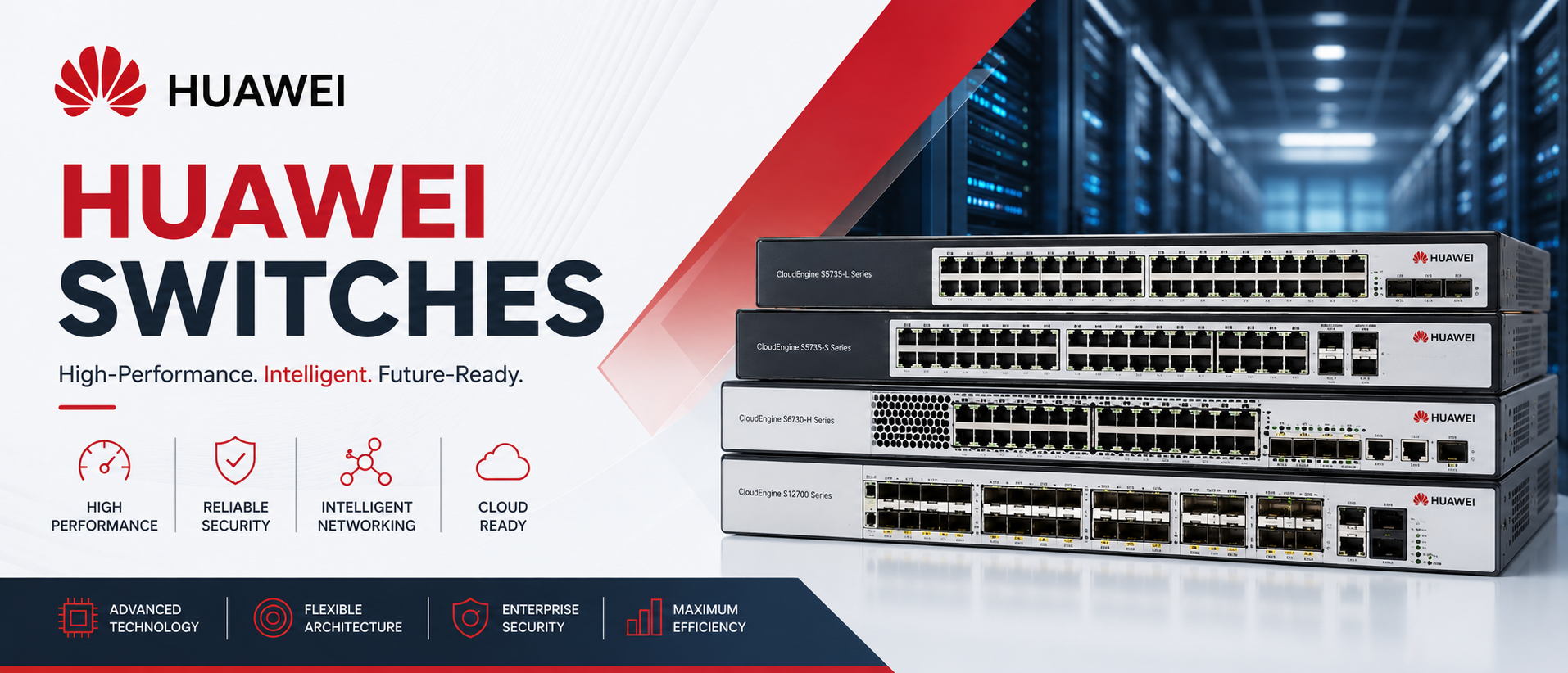
Huawei Switches: New CloudEngine Enterprise Switches for Campus, Access, and Core Networks
Huawei CloudEngine switches power enterprise networks across government, healthcare, education, banking, and data center environments worldwide — known for dense port configurations, mature Layer 3 routing, and a switching architecture built to scale from a single access closet to a fully virtualized campus fabric.
Netseg supplies 100% new, factory-sealed Huawei CloudEngine switches, from compact S5735 access switches to modular S12700 core chassis platforms, with genuine hardware, full manufacturer warranty eligibility, and fast shipping across the UAE, Saudi Arabia, the wider GCC, and Africa.
Whether you’re specifying access-layer switching for a school, PoE-powered distribution for a hospital, or a modular core for a government data center, our team matches the right CloudEngine model to your port count, PoE budget, routing requirements, and redundancy needs — with a formal quotation typically returned the same business day.
Talk to a Huawei networking specialist today — request pricing, ask about bulk or tender-based procurement, or get help choosing between S5735-S and S6730 for your next network refresh.
What Are Huawei Switches?
Huawei switches are enterprise-grade Ethernet switches built around the CloudEngine product family and Huawei’s VRP (Versatile Routing Platform) operating system — a single OS foundation that spans Huawei’s switching, routing, and some security product lines, giving network teams one consistent command syntax across much of their Huawei estate.
CloudEngine switches serve three broad roles in an enterprise network:
- Access layer — connecting end devices (laptops, IP phones, access points, PoE cameras, IoT sensors) to the network. This is where the S5735 family (S5735-L, S5735-S) and S5732/S5755 series typically sit.
- Distribution/aggregation layer — collecting traffic from access switches, applying policy, and routing it toward the core. The S6730 and S6750 series commonly serve this role, offering deeper Layer 3 routing and higher-density uplinks.
- Core layer — the high-capacity backbone of a campus or data center network. Huawei’s S7700, S8700, and S12700 series are modular chassis platforms built for this tier, supporting hot-swappable line cards, redundant control boards, and very high switching capacity.
Huawei’s networking portfolio is increasingly built around AI-driven, cloud-managed operations. iMaster NCE (Network Cloud Engine) is Huawei’s centralized management and control platform — used to automate onboarding (via Zero Touch Provisioning), push configuration through NETCONF/YANG interfaces, and provide network-wide visibility and telemetry. Older deployments, or organizations that prefer not to adopt centralized cloud/SDN management, can continue managing CloudEngine switches through traditional CLI or Huawei’s legacy eSight network management software.
Layer 2 switching (VLANs, spanning tree, link aggregation) is standard across the CloudEngine line. Layer 3 capability — static routing, OSPF, IS-IS, BGP, VRRP — is present on most models above entry-level access switches, with more advanced routing and VXLAN/EVPN fabric features concentrated in the S6700+ and S7700/S8700/S12700 tiers.
Why Choose Huawei Switches?
Performance. Huawei’s CloudEngine architecture is built for high port density and strong forwarding performance at every tier — from gigabit access switching up to multi-terabit modular chassis platforms at the core.
Reliability. Redundant power supplies, hot-swappable fan trays, and (on chassis platforms like S8700/S12700) dual, hot-standby main control boards mean a single hardware fault doesn’t have to mean an outage.
Security. MACsec encryption, granular ACLs, and Huawei’s broader security ecosystem integration give network and security teams the tools to enforce segmentation and protect data in transit at the switching layer.
Scalability. Stacking (on fixed-configuration models) and modular chassis expansion (on S7700/S8700/S12700) let a network grow from a single switch to a large, highly available core without a forklift replacement.
Energy efficiency. Huawei has invested in power-efficient silicon and intelligent fan/power management across the CloudEngine range — relevant for organizations tracking data center and campus energy costs.
Cloud management (optional). iMaster NCE brings AI-assisted automation, telemetry, and centralized policy to organizations that want it, without forcing every deployment onto a cloud-managed model.
Lower total cost of ownership. A single VRP-based OS across switches and (in many networks) routers reduces the training and tooling burden on network teams, and Huawei’s competitive hardware pricing is frequently cited as a factor in total project cost versus some Western vendors.
Future-ready networking. VXLAN/EVPN fabric support on higher-tier models lets organizations build a scalable, virtualized campus network architecture that can extend toward data-center-style overlay networking as requirements grow.
Key Features Of Huawei Switches
CloudEngine Architecture — Huawei’s unified enterprise switching architecture spanning fixed-configuration access switches through modular chassis core platforms, all sharing common management, feature parity philosophy, and a consistent OS foundation.
VRP (Versatile Routing Platform) — Huawei’s proprietary operating system, providing a consistent CLI and configuration model across CloudEngine switches (and, in many networks, Huawei routers). This consistency reduces the learning curve for teams operating a mixed Huawei environment.
Layer 2 & Layer 3 Switching — VLAN segmentation, spanning tree protocols (STP/RSTP/MSTP), and — on Layer 3-capable models — static and dynamic routing (OSPF, IS-IS, BGP) plus VRRP for gateway redundancy.
VXLAN — A network virtualization technology that extends Layer 2 segments across a routed Layer 3 network, letting organizations build large, flexible virtual networks without being constrained by traditional VLAN scaling limits.
EVPN — Often paired with VXLAN, EVPN provides the control-plane protocol for dynamically establishing VXLAN tunnels and building a Unified Virtual Fabric (Huawei’s terminology) across campus and data center environments — supported on Huawei’s higher-tier campus and data center switches including the S12700E series.
M-LAG (Multi-Chassis Link Aggregation) — Lets two physical switches present themselves as a single logical switch to a connected device or link-aggregation group, providing redundancy without the limitations of traditional stacking — commonly used at the distribution/core layer for high-availability designs.
Stacking — Combines multiple fixed-configuration switches (such as S5735 or S6730 models) into a single logically managed unit, simplifying operations and adding resilience at the access/aggregation layer.
MACsec — Hop-by-hop Layer 2 encryption protecting data in transit between switches, relevant for organizations with compliance requirements in finance, healthcare, and government.
ACL (Access Control Lists) — Granular traffic filtering rules used to enforce security policy directly at the switching layer, restricting which devices or traffic types can communicate across network segments.
QoS (Quality of Service) — Traffic prioritization ensuring latency-sensitive applications (voice, video conferencing) get precedence over bulk data transfer during periods of network congestion.
IPv6 — Full dual-stack IPv4/IPv6 support across CloudEngine switches, important for organizations with IPv6 transition mandates (common in government and telecom procurement).
PoE / PoE+ / PoE++ — Power delivery to connected devices over Ethernet cabling. Access-layer CloudEngine switches (S5735 family) commonly offer PoE/PoE+ power budgets in the 380–400W range per switch (model-dependent), sufficient for IP phones, standard access points, and PoE cameras; higher-draw deployments should be sized against the specific model’s PoE budget.
High Availability — Redundant hardware components plus protocols like VRRP and, on chassis platforms, dual hot-standby main control boards, minimizing single points of failure.
Redundant Power Supply — Dual (or, on larger chassis platforms, N+1) power supply configurations that keep a switch operating through a single PSU failure — standard on distribution/core-tier and chassis models.
Zero Touch Provisioning (ZTP) — Allows a new switch to automatically retrieve its configuration on first boot — either via USB or through Huawei’s iMaster NCE — significantly speeding up large rollouts across many sites.
AI-Driven Automation — Through iMaster NCE, Huawei brings AI-assisted analytics (including features like AI-based Explicit Congestion Notification on higher-end chassis platforms) to reduce manual troubleshooting and optimize traffic behavior automatically.
Huawei Switch Product Series Comparison
| Model | Best For | Port Speed | PoE | Layer 3 | Stacking | Ideal Business Size |
|---|---|---|---|---|---|---|
| S5735-L | Small office/branch access | Gigabit access, 10G uplinks | PoE/PoE+ (~380–400W budget, model-dependent) | Basic | Yes | Small office, small branch |
| S5735-S | Campus/MAN access & aggregation | Gigabit access, 10G uplinks | PoE options available | Enhanced (OSPF, IS-IS, BGP, VRRP) | Yes | SMB, mid-size branch/campus |
| S5732 | Compact enterprise access | Gigabit access, 10G uplinks | PoE options available | Enhanced L3 | Yes | SMB to mid-size enterprise |
| S5755 | High-quality gigabit access | Gigabit access, 10G uplinks | PoE options available | Enhanced L3 | Yes | Mid-size enterprise, campus |
| S6730 | Distribution/aggregation | Gigabit/10GbE access, higher-speed uplinks | Select PoE models | Full L3, VXLAN-capable | Yes | Mid-size to large enterprise |
| S6750 | High-performance distribution | 10GbE and above | Select models | Full L3, VXLAN-capable | Yes | Large enterprise, data center access |
| S7700 | Modular campus core | Modular line cards up to 100GbE | Select line cards | Full L3, VXLAN/EVPN | N/A (chassis redundancy) | Large enterprise, campus core |
| S8700 | High-density modular core/aggregation | Modular line cards, high-density 10GbE/40GbE/100GbE | Select line cards | Full L3, VXLAN/BGP-EVPN, MACsec | N/A (chassis redundancy, dual MPU) | Large enterprise, government, campus core |
| S12700 | Flagship modular campus core | Modular line cards up to 100GbE | Select line cards | Full L3, VXLAN/EVPN | N/A (chassis redundancy) | Very large enterprise, government, telecom |
Exact port counts, PoE budgets, and licensing vary by specific SKU and hardware revision (e.g., “-V2” variants). Our team confirms exact specifications against your requirements before quoting.
Industries That Use Huawei Switches
- Government — Segmented, auditable networks with strong Layer 3 policy control and IPv6 readiness for public-sector mandates.
- Healthcare — Reliable PoE-powered access for clinical devices and cameras, MACsec for data-in-transit protection of sensitive patient data networks.
- Education (Schools & Universities) — Cost-effective, dense access switching for classrooms and dormitories, with stacking to simplify management across large campuses.
- Hospitality — Large-property PoE deployments for access points and guest/staff network separation.
- Banking & Financial Services — Security-focused deployments needing granular ACLs, MACsec, and strict segmentation between transaction and corporate networks.
- Manufacturing — Rugged, reliable switching for OT/IT convergence on factory floors.
- Warehousing & Logistics — Wide-area PoE for handheld scanners, wireless coverage, and camera networks.
- Retail — Centralized management across many branch locations via iMaster NCE.
- Oil & Gas — Reliable, high-availability networking for remote or industrial sites with demanding uptime requirements.
- Telecommunications — High-density aggregation and metro access using S6700+ and S7700/S8700 series.
- Data Centers — S8700/S12700 modular chassis switches at the campus-to-data-center boundary, with VXLAN/BGP-EVPN fabric extension.
Huawei vs Cisco Switches: A Balanced Comparison
| Factor | Huawei CloudEngine | Cisco Catalyst |
|---|---|---|
| Performance | Strong port density and forwarding performance across all tiers; modular chassis (S8700/S12700) competitive at the high end | Strong, well-proven performance across the same tiers with the largest global installed base |
| Security | MACsec, ACLs, integrated security ecosystem | MACsec, TrustSec, broad security portfolio integration |
| Licensing | Feature licensing varies by model and software version; often perceived as more straightforward at the hardware-purchase stage | Cisco DNA/Catalyst software licensing tiers, well-documented but can add material cost on top of hardware |
| Cloud Management | iMaster NCE for centralized, AI-assisted automation and telemetry | Cisco Catalyst Center or Meraki cloud dashboard |
| AI Features | AI-assisted analytics through iMaster NCE (e.g., AI ECN on chassis platforms) | Cisco has invested heavily in AI-driven assurance through Catalyst Center |
| Automation | NETCONF/YANG support, ZTP | NETCONF/RESTCONF, ZTP, strong third-party automation tooling ecosystem |
| Scalability | Stacking at fixed-configuration tiers; modular chassis (S7700/S8700/S12700) at the core | StackWise stacking; Catalyst 9600 modular chassis at the core |
| Total Cost of Ownership | Frequently competitive on hardware pricing; can offer strong value at equivalent performance tiers | Premium pricing generally reflecting brand position and the size of its certification/support ecosystem |
Bottom line:Both vendors serve demanding enterprise environments reliably. Organizations prioritizing hardware value and dense port configurations often find Huawei CloudEngine compelling; organizations with deep existing investment in Cisco’s certification ecosystem (CCNA/CCNP) and IOS-XE-based tooling may find Catalyst a more familiar operational fit. The right choice depends on procurement priorities, existing skills, and specific compliance/certification requirements for your sector and region.
Huawei vs Juniper Switches
- Operating System: Huawei’s VRP and Juniper’s Junos OS both provide a consistent CLI across their respective switch (and router) portfolios — the difference is mainly which ecosystem your team is already trained on.
- Cloud/AI Management: Huawei’s iMaster NCE and Juniper Mist both bring AI-assisted operations to their platforms; Juniper’s Marvis assistant has a strong reputation specifically in unified wired/wireless assurance, while iMaster NCE is deeply integrated across Huawei’s broader campus and data center portfolio.
- Fabric Technology: Both support VXLAN/EVPN for building virtualized campus and data center fabrics, with largely comparable capability at the architecture level.
- Regional Support & Availability: Huawei often has stronger regional distribution and stock availability across the Middle East, GCC, and Africa — a practical consideration for procurement timelines in these regions.
- Price: Huawei hardware is frequently positioned competitively against Juniper at similar performance tiers, though exact positioning varies by specific model and current market pricing.
Bottom line: Both are credible, modern enterprise switching platforms. Regional stock availability, existing team familiarity, and specific fabric/automation requirements should drive the decision more than a categorical performance gap.
Huawei vs Aruba Switches
- Ecosystem Fit: Aruba integrates tightly with Aruba wireless access points and Aruba Central for unified wired/wireless management; Huawei CloudEngine integrates similarly with Huawei’s own AP and iMaster NCE ecosystem. Organizations already standardized on one vendor’s wireless typically gain the most from staying within that same vendor’s switching line.
- Cloud Management: Aruba Central and Huawei’s iMaster NCE both offer centralized, AI-assisted management; feature depth varies by specific deployment scenario and license tier.
- Hardware Density & Pricing: Huawei is frequently competitive on port density and price at comparable performance tiers, particularly at the access and distribution layers.
- Global Support Footprint: Aruba (HPE) has a very large global partner and support network; Huawei’s support footprint is strong in the Middle East, Africa, and Asia-Pacific in particular, which can be an advantage for organizations operating primarily in these regions.
Bottom line: The decision often comes down to existing wireless vendor alignment and regional support/stock preferences rather than a clear technical advantage for either platform.
How to Choose the Right Huawei Switch?
1. Count your users and devices per wiring closet. Small offices may only need a compact S5735-L; dense campus floors typically need 24- or 48-port S5735-S or S6730 switches, often stacked.
2. Identify your PoE requirements. Match your expected PoE load (phones, standard APs vs. high-draw Wi-Fi 6 APs, PTZ cameras) against the specific model’s PoE power budget — this varies materially between SKUs even within the same series.
3. Check fiber and uplink needs. If your distribution or core layer runs 10GbE or higher, confirm your access switch’s uplink speed matches, and plan S6730/S6750 or higher for distribution-tier bandwidth.
4. Assess 10G/25G requirements now and for future growth. Higher-density campuses and data center edges increasingly need 10G/25G at the distribution layer even if today’s access layer is still gigabit.
5. Plan for future expansion. Stacking (fixed-configuration models) and modular chassis slots (S7700/S8700/S12700) let you scale capacity without a full replacement — but only if the model line you choose supports the growth path you’ll need.
6. Set a realistic budget, including licensing. Confirm whether the routing features, VXLAN/EVPN fabric capability, or iMaster NCE management tier you need require a specific software license, and factor that into total project cost.
7. Decide on your management model. Organizations centralizing operations across many sites benefit from iMaster NCE’s automation and AI-assisted analytics; smaller or single-site deployments may be well served by traditional CLI/eSight management without additional licensing.
8. Prioritize redundancy for mission-critical environments. Hospitals, data centers, and government facilities should prioritize models with dual power supplies and — for core-tier deployments — modular chassis platforms with hot-standby main control boards.
Not sure which CloudEngine model fits your project? Request a free technical consultation — our team will review your port count, PoE load, and routing requirements and recommend the right model(s) before you commit to a quote.
Why Buy Huawei Switches From Netseg?
- Genuine Products — 100% new, factory-sealed Huawei CloudEngine switches with authentic hardware and firmware; no gray-market or refurbished stock.
- Competitive Pricing — request a quote for single-unit or bulk/project orders, including government tender pricing where applicable.
- Worldwide Shipping — fast delivery across the UAE, Saudi Arabia, the wider GCC, Africa, and international destinations on request.
- Fast Quotations — most quote requests are answered within the same business day.
- Bulk Discounts — tiered pricing for schools, hospitals, government projects, and system integrator orders.
- Enterprise Support — dedicated account handling for large or recurring procurement needs.
- Technical Consultation — our team helps match the right model, port density, PoE tier, and licensing to your actual project requirements before you buy.
- Pre-Sales & After-Sales Support — configuration guidance before purchase and technical support after deployment.
Ready to spec out your next Huawei CloudEngine deployment? Contact Netseg for a same-day quotation.
-

CE16808-DC
Detail :Huawei CE16808 DC assembly chassis
Condition : New Factory Sealed
Models : CE16808-DC - Huawei CloudEngine 12800 Series Data Center Switches
Call for Price
CE16808-DC
Call for Price
-

CE16808-AH
Detail :Huawei CE16808 AC/HVDC assembly chassis
Condition : New Factory Sealed
Models : CE16808-AH - Huawei CloudEngine 12800 Series Data Center Switches
Call for Price
CE16808-AH
Call for Price
-

CE16808A-B00
Detail :Huawei CE16808 AC Bundle0 (AC/HVDC Assembly Chassis, 2*MPUD, 3*SFU08F, 2* 3000W AC & HVDC, full Fans)
Condition : New Factory Sealed
Models : CE16808A-B00 - Huawei CloudEngine 12800 Series Data Center Switches
Call for Price
CE16808A-B00
Call for Price
-

CE16808A-B02
Detail :Huawei CE16808 AC Bundle2 (AC/HVDC Assembly Chassis, 2*MPUD, 5*SFU08G, 4* 3000W AC & HVDC, full Fans)
Condition : New Factory Sealed
Models : CE16808A-B02 - Huawei CloudEngine 12800 Series Data Center Switches
Call for Price
CE16808A-B02
Call for Price
-

CE16808A-B01
Detail :Huawei CE16808 AC Bundle1 (AC/HVDC Assembly Chassis, 2*MPUD, 4*SFU08F, 4* 3000W AC & HVDC, full Fans)
Condition : New Factory Sealed
Models : CE16808A-B01 - Huawei CloudEngine 12800 Series Data Center Switches
Call for Price
CE16808A-B01
Call for Price
-

CE16816-AH
Detail :Huawei CE16816 AC/HVDC assembly chassis
Condition : New Factory Sealed
Models : CE16816-AH - Huawei CloudEngine 12800 Series Data Center Switches
Call for Price
CE16816-AH
Call for Price
-

CE-MPUD-HALF
Detail :Huawei CE16800 Main Processing Unit D (half-width)
Condition : New Factory Sealed
Models : CE-MPUD-HALF - Huawei CloudEngine 12800 Series Data Center Switches
Call for Price
CE-MPUD-HALF
Call for Price
-

CE16816-DC
Detail :Huawei CE16816 DC assembly chassis
Condition : New Factory Sealed
Models : CE16816-DC - Huawei CloudEngine 12800 Series Data Center Switches
Call for Price
CE16816-DC
Call for Price
-

CE-MPUD-FULL
Detail :Huawei CE16800 Main Processing Unit D (full-width)
Condition : New Factory Sealed
Models : CE-MPUD-FULL - Huawei CloudEngine 12800 Series Data Center Switches
Call for Price
CE-MPUD-FULL
Call for Price
-

CE-SFU04F-G
Detail :Huawei CE16804 Switch Fabric Unit F
Condition : New Factory Sealed
Models : CE-SFU04F-G - Huawei CloudEngine 12800 Series Data Center Switches
Call for Price
CE-SFU04F-G
Call for Price
-

CE6820-48S6CQ-B
Detail :Huawei CE6820-48S6CQ-B switch (48*10G SFP+, 6*100G QSFP28, 2*AC power modules, 4*fan modules, port-side intake), Part Number: 02352TLG
Condition : New Factory Sealed
Models : CE6820-48S6CQ-B - Huawei CloudEngine 6800 Data Center Switches
Call for Price
CE6820-48S6CQ-B
Call for Price
-

CE8850-EI-B-B0A
Detail :CE8850-32CQ-EI Switch(32-Port 100GE QSFP28,2-Port 10GE SFP+,2*AC Power Module,2*FAN Box,Port-side Intake)
Condition : New Factory Sealed
Models : CE8850-EI-B-B0A - Huawei CE8800 Data Center Switches
Call for Price
CE8850-EI-B-B0A
Call for Price