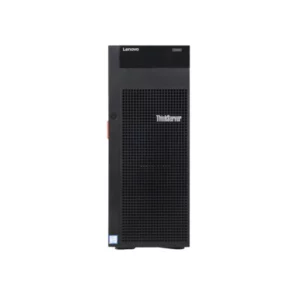
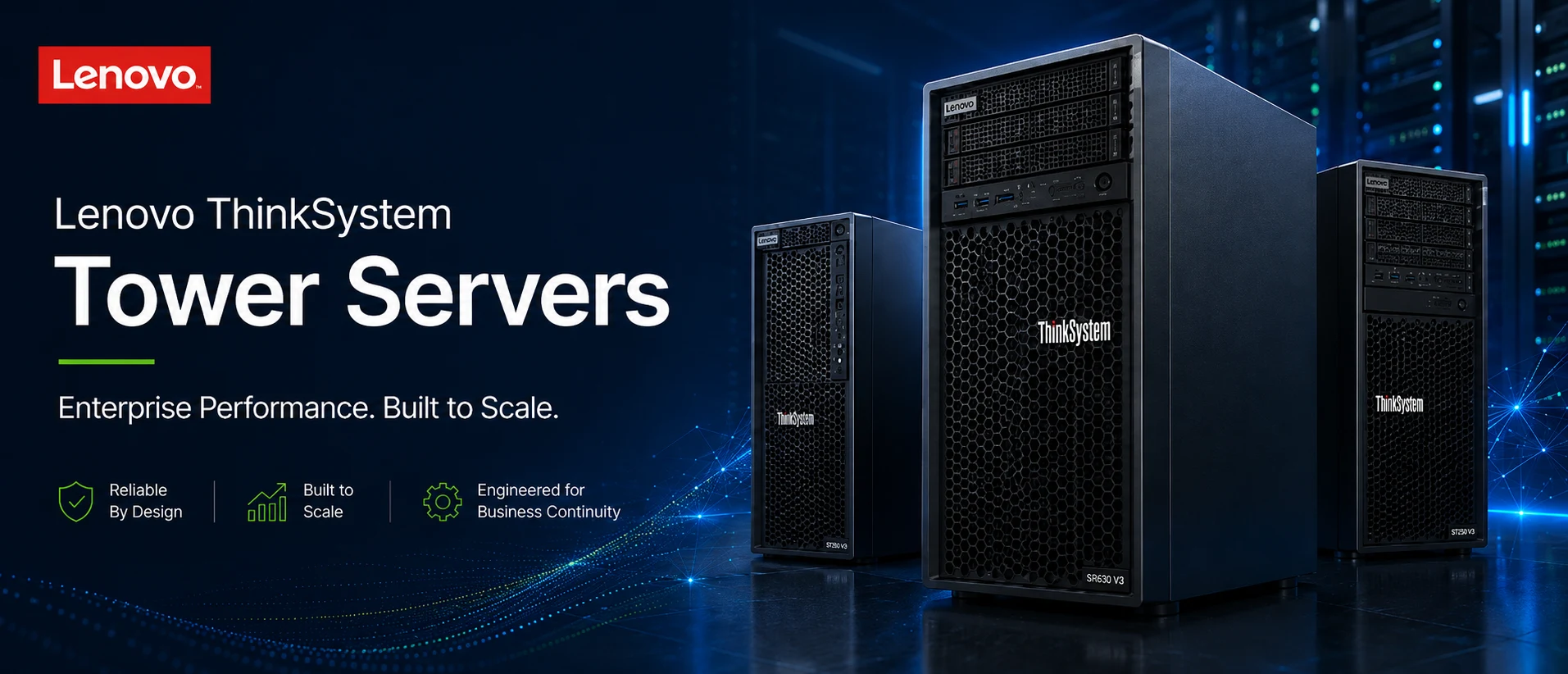
Lenovo ThinkSystem Tower Servers in UAE & GCC
Lenovo ThinkSystem tower servers provide business-grade compute, storage and management capabilities in a standalone chassis that can suit offices, branch locations and enterprise IT environments where a traditional rack deployment is not always practical.
NETSEG offers Lenovo tower server solutions for organizations sourcing business infrastructure in the UAE and across the GCC. The ThinkSystem tower range covers different requirements, from compact entry-level servers for everyday business applications to expandable systems designed for virtualization, databases and more demanding enterprise workloads.
Businesses evaluating a Lenovo tower server should choose the model and configuration according to workload, processor demand, memory requirements, storage capacity, RAID strategy, networking, redundancy and expected growth rather than selecting a server only by its base specification.
Lenovo ThinkSystem Tower Servers for Business
A tower server is useful when an organization needs dedicated server hardware without building a full rack-based environment. It can operate in an office, server room, remote site or branch location while providing capabilities that conventional desktop PCs are not designed to deliver.
Lenovo ThinkSystem tower servers can support workloads such as file services, business applications, local databases, backup infrastructure, remote-office applications and virtualization when correctly configured.
They can be particularly useful for organizations that:
- need their first dedicated business server;
- operate branch or remote offices;
- require local file or application infrastructure;
- want room for storage and hardware expansion;
- need centralized server management;
- prefer a tower deployment but may require rack conversion later;
- are consolidating several small workloads onto dedicated server hardware.
The appropriate model depends heavily on workload. A small file server and a virtualization host serving multiple business applications should not be specified in the same way.
Lenovo Tower Server Models
Lenovo ThinkSystem ST50 V3
The Lenovo ThinkSystem ST50 V3 is an entry-level, single-socket tower server designed for growing businesses, remote locations and branch-office infrastructure.
It is a practical starting point for organizations moving business services away from desktop hardware or introducing a dedicated server for tasks such as file sharing, basic applications, local infrastructure services and selected light virtualization workloads.
The ST50 V3 platform supports current-generation server technologies including Intel Xeon processor options, DDR5 ECC memory, PCIe Gen5 expansion and Lenovo XClarity management capabilities.
Its compact tower format also makes it suitable for locations that do not operate a conventional data-center rack.
Consider the ST50 V3 when your priority is:
- an entry-level business server;
- file and document services;
- small-office applications;
- branch or remote-office infrastructure;
- directory or infrastructure services;
- backup or supporting workloads;
- a compact server footprint.
The required CPU, memory and storage configuration should still be sized against the actual application rather than treating every ST50 V3 configuration as interchangeable.
Lenovo ThinkSystem ST250 V3
The Lenovo ThinkSystem ST250 V3 provides more expansion flexibility for organizations whose storage, application or infrastructure requirements are likely to grow.
It is a single-socket ThinkSystem tower server intended for growing businesses and remote deployments and supports DDR5 memory, PCIe Gen5 connectivity, flexible drive configurations and hardware RAID options.
Compared with an entry-level tower server, the ST250 V3 is particularly useful where greater storage flexibility, expansion capacity or resilience is required.
Typical use cases can include:
- business applications;
- file and print infrastructure;
- growing databases;
- branch-office systems;
- backup infrastructure;
- business management applications;
- selected virtualization deployments;
- edge and remote-site applications.
For an organization deciding between the ST50 V3 and ST250 V3, storage requirements and expansion plans can be just as important as raw CPU performance. If the environment requires more drive bays, hardware RAID options, additional PCIe expansion or stronger power-supply flexibility, the ST250 V3 may provide a better foundation.
Lenovo ThinkSystem ST650 V3
The Lenovo ThinkSystem ST650 V3 occupies a substantially higher performance and expansion class.
It is a two-socket-capable tower platform based on Intel Xeon Scalable processors and is intended for organizations that require considerably greater compute, memory, storage and I/O flexibility than entry-level tower servers can provide.
The ST650 V3 can suit workloads such as:
- virtualization;
- larger databases;
- enterprise applications;
- virtual desktop infrastructure;
- private-cloud workloads;
- infrastructure management;
- collaboration systems;
- demanding business applications;
- compute-intensive workloads.
It can be deployed as a tower and can also support rack-based deployment, making it relevant to organizations that need substantial server capability without immediately standardizing every location on a conventional rack-server platform.
The ST650 V3 should not automatically be selected simply because it is the larger model. If the workload can be handled efficiently by a single-socket system, an ST50 V3 or ST250 V3 may provide a more appropriate architecture.
Which Lenovo Tower Server Is Right for Your Business?
The simplest way to evaluate the range is to start with the workload.
ST50 V3: consider it for entry-level business infrastructure, branch offices, file services and less demanding applications.
ST250 V3: consider it when the workload needs greater storage flexibility, expansion, RAID options or room for business growth.
ST650 V3: evaluate it for higher-demand virtualization, databases and enterprise workloads requiring significantly greater compute and expansion capability.
User count alone should not determine server size. Ten employees working with a demanding database may require more infrastructure than fifty users accessing simple shared files.
Before choosing a model, document:
- applications that will run on the server;
- expected number of simultaneous users;
- virtual machines, if any;
- current and projected data capacity;
- required backup strategy;
- network throughput;
- resilience requirements;
- operating system or hypervisor;
- planned growth over the server lifecycle.
This produces a much more useful specification than choosing a server from a model name or entry price.
Lenovo Tower Servers for Different Workloads
File, Backup and Business Applications
File services and general business applications often place moderate demands on the processor but can be sensitive to storage performance and resilience.
For these environments, consider usable storage capacity, RAID requirements, backup design and network connectivity before spending heavily on CPU resources that the workload may never use.
The ST50 V3 can suit smaller deployments, while the ST250 V3 provides additional flexibility where storage or expansion requirements are expected to increase.
Branch and Remote Office Infrastructure
A tower server can be attractive for a branch location because the site may need dedicated local infrastructure but may not justify a complete rack deployment.
Applications can include file services, directory services, local business systems, backups and other infrastructure that benefits from remaining available even when connectivity to a primary site is constrained.
Remote-management capabilities should be considered when there is limited technical staff at the location.
Virtualization and Databases
Virtualization changes the sizing process because several workloads may compete for the same processor, memory, storage and network resources.
Before specifying a Lenovo tower server as a virtualization host, estimate:
- number of virtual machines;
- virtual CPU requirements;
- allocated and peak RAM;
- storage IOPS;
- usable capacity;
- network throughput;
- growth allowance;
- recovery requirements.
Smaller virtualization deployments may be possible on appropriately configured ST50 V3 or ST250 V3 systems. More demanding consolidation, database or enterprise workloads may justify evaluating the ST650 V3.
Always verify hypervisor, operating-system, storage-controller and RAID compatibility for the exact configuration.
Higher-Demand Enterprise Workloads
Business-critical applications, larger databases and substantial virtualization environments generally benefit from a platform designed with greater compute, memory, I/O and redundancy options.
This is where the ST650 V3 becomes more relevant.
The procurement decision should nevertheless start with workload sizing. Purchasing excessive hardware increases cost, while undersizing a server can create performance problems and force an earlier replacement.
How to Configure a Lenovo Tower Server
Processor and Workload
The correct processor depends on the application.
Some workloads benefit from higher core counts and parallel processing, while others depend more heavily on per-core performance. Software licensing can also be affected by processor or core count.
Document the application and licensing model before finalizing the CPU.
Memory
RAM should be sized using the operating system, applications, databases and virtualization requirements.
Virtualization usually increases memory demand because each virtual machine requires its own allocation. Database and caching workloads can also benefit significantly from additional memory.
Plan for future growth rather than filling the available capacity without a reason.
Storage and RAID
Storage design has a major influence on server performance and resilience.
Consider:
- usable capacity;
- read/write workload;
- HDD versus SSD;
- SATA, SAS or NVMe where supported;
- drive count;
- RAID level;
- hardware RAID requirements;
- backup and recovery;
- future capacity growth.
RAID protects against specific drive failures but is not a replacement for backup.
The exact controller, drive type and RAID configuration should also be checked against the intended operating system or hypervisor.
Networking and Expansion
A server must connect efficiently to the rest of the infrastructure.
Assess current switching capacity, required Ethernet speeds, available PCIe expansion, storage connectivity and whether additional network interfaces will be needed for virtualization, backups or application traffic.
Redundancy and Future Growth
Redundancy becomes increasingly important as the workload becomes more critical.
Depending on the server model and configuration, evaluate power-supply resilience, RAID, spare capacity, network redundancy and backup architecture.
Growth should also be considered at the quotation stage. Adding suitable expansion headroom can be more efficient than replacing a server prematurely.
Lenovo Tower Servers vs Rack Servers
A tower server generally makes sense when an organization needs dedicated business infrastructure but does not operate a high-density rack environment.
Tower servers can be useful for:
- small and medium business locations;
- offices without dedicated racks;
- branch sites;
- remote facilities;
- environments with only one or a few physical servers.
Rack servers become more attractive when an organization operates many servers, wants centralized cabling and cooling, needs higher equipment density or already maintains a structured data-center rack environment.
Neither format is universally better.
The decision should reflect the physical site, number of systems, cooling, expansion plan and workload architecture.
Organizations planning rapid infrastructure growth should also compare NETSEG’s Lenovo rack server range before finalizing the form factor.
Why Businesses Choose Lenovo ThinkSystem Tower Servers
Lenovo ThinkSystem tower platforms provide a path from entry-level business computing to considerably more capable enterprise infrastructure.
Key reasons organizations evaluate them include:
- server-class processors;
- ECC memory support;
- flexible storage options;
- RAID capabilities depending on configuration;
- centralized management features;
- office and branch deployment options;
- expansion capability;
- support for established server operating systems and virtualization platforms.
The real value comes from choosing the correct configuration rather than simply buying the highest specification available.
A server sized around the workload can provide better cost control and a clearer upgrade path.
Lenovo Tower Servers in UAE, Saudi Arabia & GCC
Organizations sourcing Lenovo ThinkSystem tower servers in the UAE, Saudi Arabia or other GCC markets should include both the technical configuration and delivery destination when requesting pricing.
For UAE projects, requirements may involve offices and infrastructure deployments in Dubai, Abu Dhabi or other Emirates.
Saudi procurement requests can similarly include the required city or project location such as Riyadh, Jeddah or Dammam.
For Qatar, Kuwait, Bahrain and Oman enquiries, providing the final delivery location during the quotation process helps ensure that the commercial requirement is assessed correctly.
Avoid selecting a server only from an advertised base configuration. Processor, memory, storage, RAID, network interfaces, operating system requirements and quantity can materially change the correct bill of materials.
Request Lenovo Tower Server Pricing from NETSEG
For a more accurate Lenovo tower server quotation, provide NETSEG with as much of the following information as possible:
- preferred ThinkSystem model;
- required processor or workload;
- RAM capacity;
- storage type and capacity;
- RAID requirements;
- network interface requirements;
- operating system or hypervisor;
- quantity;
- delivery country and city.
If the exact model is not yet known, provide the workload instead.
Explain what applications will run on the server, approximate user count, virtualization requirements, current storage capacity and expected growth. This gives the sales team a stronger basis for identifying an appropriate ThinkSystem platform.
Need help selecting between the Lenovo ThinkSystem ST50 V3, ST250 V3 and ST650 V3? Contact NETSEG to discuss your server requirements and request a configuration-based quotation.
Lenovo Model Comparison Table
This comparison uses current Lenovo documentation rather than reseller descriptions. ST50 V3 supports Xeon E-2400/6300-series processors, DDR5 and up to 128 GB memory; ST250 V3 expands storage and PCIe options while remaining single-socket; ST650 V3 scales to one or two 4th/5th Gen Xeon Scalable processors, up to 4 TB of memory and much larger storage/I/O configurations.
| Feature | ST50 V3 | ST250 V3 | ST650 V3 |
|---|---|---|---|
| Positioning | Entry business | Growing business | Enterprise/high performance |
| CPU platform | 1 socket, Xeon 6300/E-2400 | 1 socket, Xeon 6300/E-2400 | 1–2 sockets, 4th/5th Gen Xeon Scalable |
| Memory technology | DDR5 ECC | DDR5 ECC | DDR5 ECC |
| Verified maximum memory | Up to 128 GB | Up to 128 GB | Up to 4 TB |
| PCIe | Gen5 support | Up to 4 slots; Gen5 support | Up to 9 slots; Gen5/Gen4 |
| Storage positioning | Entry/moderate | Significantly more flexible | Storage-rich enterprise platform |
| RAID | Supported options | Hardware RAID options | Extensive RAID/HBA/VROC options |
| Management | XClarity | XClarity Controller 2 | XClarity Controller 2 |
| Good starting point for | File/office/branch workloads | Growing SMB infrastructure | Virtualization/databases/enterprise |
| Virtualization | Possible when correctly configured | Suitable for appropriately sized deployments | Strong enterprise virtualization fit |
| Tower/rack flexibility | Rack conversion available | Rack conversion available | Tower or 4U rack |
| Relative expansion | Lower | Medium | High |
The ST650 V3’s product guide specifically positions it for databases, virtualization, cloud computing, VDI, enterprise applications and HPC.
-
Lenovo ThinkSystem ST250 V3 Server
Detail :Single-socket tower server with Intel Xeon 6300/E-2400 processors, up to 128GB DDR5 ECC memory, flexible SAS/SATA/NVMe storage, hardware RAID, PCIe expansion, and Lenovo XClarity management.
Condition : Brand New
Models :
Call for Price
Lenovo ThinkSystem ST250 V3 Server
Call for Price
-
-