
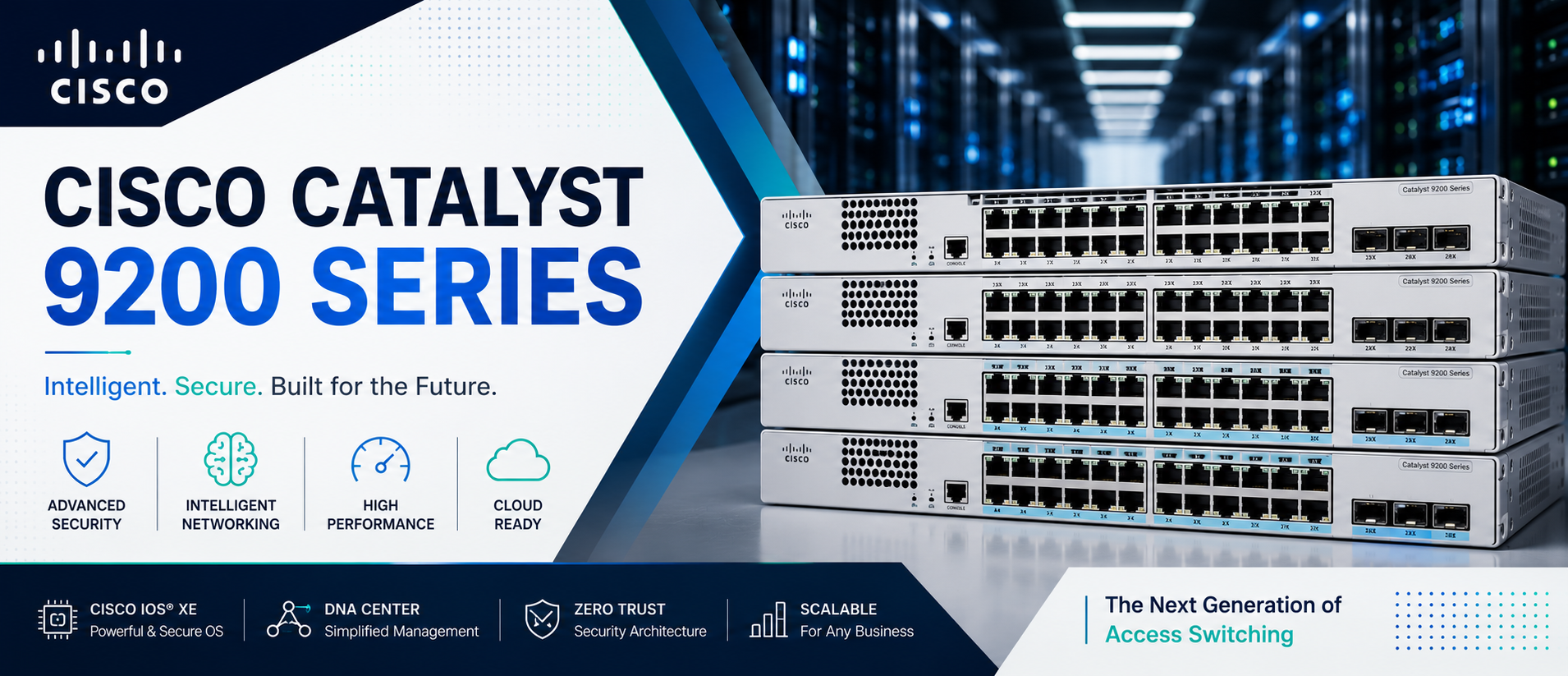
Cisco Catalyst 9200 Series Switches — Enterprise Access Switching for the GCC
Cisco Catalyst 9200 Series switches are the access-layer backbone for organizations across the UAE, Saudi Arabia, Qatar, Oman, Bahrain, and Kuwait that need a stackable, secure, and centrally managed switching platform without paying for core-layer capacity they will never use. Netseg supplies genuine Cisco Catalyst 9200 and 9200L hardware, correctly matched licensing, and pre-sales engineering support to enterprises, government entities, hospitals, banks, universities, hotels, and system integrators across the region. If your project requires enterprise pricing, stock confirmation, or a technical comparison before you commit to a purchase order, our team can respond the same business day.
The Cisco Catalyst 9200 Series is Cisco’s entry point into the Catalyst 9000 architecture, built for branch offices, campus access layers, and mid-sized enterprise networks that need Cisco IOS XE consistency, StackWise resiliency, and Cisco Catalyst Center compatibility at a lower cost than the Catalyst 9300 or 9400 families. It replaced the older Catalyst 2960-X and 3650 fixed-configuration switches as Cisco’s standard access-layer recommendation, bringing a modern UADP ASIC, open programmable APIs, and a unified software base shared across the entire Catalyst 9000 portfolio. For IT managers and procurement teams across the GCC, this matters because it means every Catalyst 9200 you deploy today stays on the same operating system and licensing model as the 9300 and 9400 switches you may deploy tomorrow, simplifying training, automation, and lifecycle planning.
Why Choose Cisco Catalyst 9200?
Enterprises choose the Catalyst 9200 Series because it delivers Cisco’s core reliability and security stack at an access-switch price point, without forcing a compromise on manageability. It runs the same Cisco IOS XE software as higher-end Catalyst switches, supports Cisco Catalyst Center for centralized visibility, and offers StackWise stacking for up to 384 access ports under a single management plane. Full PoE+ is available on up to 48 ports per switch, which matters for organizations rolling out Wi-Fi 6/6E access points, IP phones, surveillance cameras, and IoT sensors from the same switch. Combined with dual power supplies, field-replaceable fans, and switch-level high availability, the platform is built to keep branch and campus access layers running with minimal unplanned downtime — a priority for banks, hospitals, and government networks where access-layer outages have real operational cost.
Who Should Buy the Catalyst 9200?
The Catalyst 9200 is designed for the access layer, not the core or distribution layer. It is the right fit for:
- Enterprises consolidating branch or floor-level switching under one management platform
- Government departments standardizing on Cisco for security and audit requirements
- Hospitals and clinics needing PoE+ for wireless access points, nurse call systems, and medical IoT
- Banks and financial institutions requiring segmentation, MACsec, and centralized policy control at the edge
- Universities and schools needing high port density with cost-effective licensing across many buildings
- Hotels and hospitality groups deploying Wi-Fi 6/6E for guest and back-of-house networks
- Manufacturing and industrial sites needing ruggedized or PoE-heavy access switching (with 9200CX variants)
- Retail chains standardizing store-level networking across multiple locations in the GCC
- System integrators and MSPs building Cisco-based managed network offerings for enterprise clients
- Airports and transport authorities needing resilient, centrally monitored access switching across large campuses
If your requirement is core routing, high-density 100G aggregation, or advanced SD-Access fabric border/control roles, the Catalyst 9300 or 9400 Series is the correct product line — Netseg can help you determine the right split between 9200 access switches and 9300/9400 distribution switches for your topology.
Business Benefits
For a CIO, CTO, or infrastructure manager, the business case for the Catalyst 9200 comes down to lower total cost of ownership without sacrificing Cisco’s security and manageability standards. A single licensing and software model across your access layer reduces training overhead for your network engineering team. Cisco Catalyst Center integration gives IT managers a single pane of glass for provisioning, monitoring, and troubleshooting hundreds of switches across multiple GCC sites, which directly reduces the mean time to resolution during outages. PoE+ across all downlink ports also removes the need for separate power injectors, lowering both capital cost and rack space requirements in wiring closets.
Enterprise Advantages
Enterprises operating across multiple emirates, cities, or GCC countries benefit from the Catalyst 9200’s consistent behavior regardless of deployment site. The same switch model, the same IOS XE image, and the same licensing tier can be rolled out in a Dubai headquarters, a Riyadh branch, and a Doha data center annex, giving procurement teams volume-purchasing leverage and giving network engineers a single skill set to maintain. Stacking up to eight units per stack with StackWise bandwidth up to 160 Gbps means enterprises can scale port count in a wiring closet without adding management complexity, and switch-level SSO resiliency keeps the stack forwarding traffic even during individual member failures.
Technical Advantages
Technically, the Catalyst 9200 Series is built around Cisco’s UADP ASIC, the same silicon family used across the Catalyst 9000 line, giving it hardware-level support for flexible NetFlow, programmable pipelines, and future software feature additions without a hardware refresh. It supports Layer 2 switching and Layer 3 routing (feature depth depends on the Network Essentials or Network Advantage license), 802.1Q VLAN trunking, EtherChannel/LACP, QoS classification and marking, and access control lists for traffic filtering at the edge. Security capabilities include MACsec encryption on supported models, 802.1X port-based authentication, and Cisco TrustSec-based segmentation for Zero Trust network access strategies. Modular uplink options on the C9200 chassis-based models allow Gigabit Ethernet, 10G SFP+, or higher-speed uplinks to be selected per deployment, while fixed C9200L models offer set 1G/10G or 25G uplink configurations for simpler procurement.
Deployment Scenarios
Typical GCC deployment scenarios for the Catalyst 9200 include: wiring-closet access switching in office towers across Dubai and Abu Dhabi; branch-office LAN standardization for banks with dozens of retail locations across Saudi Arabia; hospital floor switching feeding PoE-powered wireless access points and nurse stations in Doha and Riyadh; university dormitory and lecture-hall networking across multiple campuses; hotel back-of-house and guest Wi-Fi backhaul in Muscat and Manama; and government office LAN refreshes replacing end-of-life Catalyst 2960 or 3560 switches ahead of Cisco end-of-support dates. In each of these, the switch typically sits at the access layer, connecting end devices and access points, while a Catalyst 9300 or 9400 handles distribution and core routing.
Industry Use Cases
- Banking & Finance: Branch LAN standardization with 802.1X authentication and MACsec for PCI-DSS-aligned segmentation
- Healthcare: PoE+ for wireless access points, nurse call panels, IoT patient monitors, and VoIP handsets on hospital floors
- Government: Centralized policy and audit logging through Cisco Catalyst Center for compliance-driven networks
- Education: High port density per building at lower cost per port for schools and university campuses
- Hospitality: Wi-Fi 6/6E backhaul for guest networks, POS systems, and back-of-house operations
- Retail: Store-in-a-box standardized switching replicated across dozens or hundreds of locations
- Manufacturing & Oil and Gas: Ruggedized 9200CX variants and PoE for industrial IoT and surveillance at plant sites
- Airports & Transport: Resilient stacked access switching across large, multi-building campuses
Key Features
- Cisco IOS XE software, shared with the entire Catalyst 9000 family
- StackWise stacking, up to 8 switches per stack, up to 384 access ports, up to 160 Gbps stack bandwidth
- Full PoE+ (802.3at) on up to 48 ports per switch; UPOE and IEEE 802.3bt Class 6 on select models (e.g., C9200CX)
- Modular uplinks (C9200) or fixed 1G/10G/25G uplinks (C9200L) for flexible network design
- Cisco Catalyst Center (formerly Cisco DNA Center) support for automation, assurance, and centralized visibility
- Cloud-managed option through Catalyst switches on the Meraki dashboard for simplified remote management
- Redundant, field-replaceable power supplies and dual fans for high availability
- Security features including 802.1X, ACLs, MACsec (select SKUs), and Cisco TrustSec segmentation
- Layer 3 routing support (RIP, EIGRP, OSPF, static routing) with feature depth tied to license tier
- Cold patching for applying select software updates with reduced downtime
Available Models
The Catalyst 9200 family spans three main product lines to match different deployment needs:
- Cisco Catalyst 9200 (chassis-based): Modular uplink network modules, field-replaceable fans, higher configurability for enterprises that need uplink flexibility across sites
- Cisco Catalyst 9200L (fixed-configuration): Fixed 1G/10G or 25G uplinks, lower entry cost, ideal for standardized branch and campus rollouts at scale
- Cisco Catalyst 9200CX (compact): Compact fixed switches designed for space-constrained wiring closets, retail back-rooms, and light industrial environments, with UPOE and IEEE 802.3bt support on select ports
Netseg stocks and sources both 24-port and 48-port variants across data-only, PoE+, and full-PoE configurations to match project specifications for enterprise, government, and system integrator procurement.
Port Configurations
Catalyst 9200 and 9200L switches are available in 24-port and 48-port downlink configurations, in data-only, PoE+ (partial), and full-PoE+ variants, paired with 4x Gigabit Ethernet, 4x 10G, or 2x 25G uplink options depending on the SKU. This range lets network engineers match port density and PoE budget precisely to floor-by-floor or building-by-building requirements instead of over-provisioning every wiring closet with the same fixed configuration.
PoE Options
Power delivery is one of the most common procurement questions we receive from hospitals, hotels, and offices deploying Wi-Fi 6/6E access points. The Catalyst 9200 supports full PoE+ (IEEE 802.3at) across all 48 downlink ports on full-PoE SKUs, while the compact C9200CX supports UPOE and IEEE 802.3bt Class 6 for higher-power devices such as PTZ cameras and Wi-Fi 6E access points that draw more than standard PoE+ budgets. Selecting the correct PoE tier upfront avoids a common and costly mistake: under-budgeting power for access points that are added after the initial network design, which forces an unplanned switch or power-supply upgrade later.
StackWise
StackWise technology allows multiple Catalyst 9200 units to operate as one logical switch with a single IP management address, a single control plane, and synchronized configuration across the stack. This is particularly valuable for GCC enterprises managing wiring closets with limited rack space, since a stack of 4–8 switches behaves as one device for monitoring, firmware updates, and troubleshooting, while still providing physical port redundancy if an individual unit fails. Note that C9200 (modular) and C9200L (fixed) SKUs cannot be mixed within the same stack, and stacking hardware (StackWise-160 or StackWise-80 kits) must be ordered separately in most SKUs — a detail our engineers routinely help buyers get right at the quotation stage to avoid delivery delays.
Uplink Options
Chassis-based C9200 models support modular uplink network modules, giving buyers a choice between Gigabit Ethernet, 10G SFP+, and higher-speed options as network requirements evolve. Fixed C9200L models ship with a set uplink configuration — typically 4x 1G, 4x 1G/10G, or 2x 25G — selected at the time of order to match the intended distribution-layer connection speed. Getting uplink sizing right is critical for avoiding an access-layer bottleneck once PoE-powered access points and IoT devices are added to the switch in volume.
Security Features
Security at the access layer is increasingly a Zero Trust requirement for GCC banks, government entities, and healthcare providers. The Catalyst 9200 supports 802.1X port-based network access control for authenticating devices before granting network access, dynamic VLAN assignment based on identity, access control lists for traffic filtering, and — on supported SKUs — MACsec line-rate encryption for protecting data in transit at the physical layer. Combined with Cisco TrustSec software-defined segmentation, organizations can enforce microsegmentation policies centrally through Cisco Catalyst Center rather than manually configuring VLANs and ACLs switch by switch, which becomes increasingly important as GCC data protection and cybersecurity regulations tighten across finance, healthcare, and government sectors.
Automation
Automation reduces the operational burden of managing dozens or hundreds of access switches spread across multiple GCC sites. Through Cisco Catalyst Center, network teams can push zero-touch provisioning to new switches, apply consistent configuration templates across an entire fleet, and receive proactive alerts before a fault becomes an outage. Open APIs on the underlying IOS XE platform also allow integration with third-party monitoring, ticketing, and orchestration tools, which matters to system integrators and MSPs building managed-service offerings around Cisco infrastructure.
Network Management
IT teams can manage the Catalyst 9200 through three operational models depending on organizational preference: traditional CLI management for engineers who prefer direct device control, on-premises Cisco Catalyst Center for enterprises requiring data sovereignty and centralized dashboards, or cloud-based management through Catalyst switches on the Meraki dashboard for organizations that want a simplified, browser-based interface with minimal on-site infrastructure. This flexibility lets government entities keep management traffic on-premises for compliance reasons while allowing hotel chains or retail groups to manage dozens of remote sites from a single cloud dashboard.
Cisco Catalyst Center Integration
Cisco Catalyst Center — the current name for what was previously branded Cisco DNA Center — is Cisco’s controller platform for network automation, assurance, and policy management. The Catalyst 9200 is fully compatible with Catalyst Center for day-0 provisioning, ongoing configuration compliance, telemetry-based health monitoring, and software image management across a fleet of switches. It is worth noting for procurement teams that deploying Catalyst Center itself is optional — the Catalyst 9200 operates correctly with CLI-only or Meraki-cloud management if an organization does not require the additional automation and analytics layer.
High Availability
High availability at the access layer is delivered through several mechanisms on the Catalyst 9200: dual, field-replaceable (or fixed, depending on SKU) fan units for thermal redundancy, optional redundant power supplies, StackWise stacking so a single unit failure does not take down the entire access layer, and Stateful Switchover (SSO) resiliency within a stack. Spanning Tree Protocol (PVST+/RPVST+/MST) support ensures loop-free topology even in multi-switch, multi-uplink designs, which is a baseline requirement for hospital, banking, and government networks where access-layer downtime has direct operational or regulatory consequences.
Power Efficiency
Full PoE+ across up to 48 ports, combined with efficient power supply options sized to the specific PoE budget required, allows organizations to right-size power draw rather than over-provisioning every switch with maximum-capacity power supplies. This is a meaningful consideration for GCC data centers and comms rooms where cooling and power costs are a direct operational expense, and where sustainability targets are increasingly part of government and large-enterprise procurement criteria.
Scalability
Because the Catalyst 9200 shares its IOS XE software base and Catalyst Center integration with the 9300, 9400, 9500, and 9600 Series, enterprises can scale from a single-building deployment to a multi-site, multi-country GCC network without re-architecting management, automation, or security policy. Stacking supports growth within a wiring closet, while consistent licensing tiers (Network Essentials/Advantage and Catalyst subscription tiers) simplify budgeting as an organization adds sites across the UAE, Saudi Arabia, Qatar, Oman, Bahrain, and Kuwait.
Future-Ready Networking
The Catalyst 9200 is built to support the access-layer demands of Wi-Fi 6 and Wi-Fi 6E deployments today, with multigigabit-capable variants available for access points that exceed standard Gigabit Ethernet throughput. As Wi-Fi 7 access points reach GCC enterprise deployments, organizations running Catalyst 9200 switches benefit from a platform that has consistently received software feature updates over its lifecycle rather than requiring a full hardware replacement for every wireless generation shift — though buyers with very high-density Wi-Fi 7 or multigigabit uplink requirements should discuss port and uplink sizing with Netseg’s engineering team before finalizing a bill of materials.
Comparison with Older Cisco Models (Catalyst 2960-X / 3650 / 3560)
Organizations still running Catalyst 2960-X, 2960-XR, or 3650 switches are typically replacing end-of-sale or end-of-support hardware. The Catalyst 9200 improves on these older platforms with a unified IOS XE software base (rather than the older IOS or IOS XE hybrid environments), StackWise stacking with higher bandwidth, native Cisco Catalyst Center compatibility, and a security feature set (802.1X, TrustSec, MACsec on select SKUs) that legacy switches were never designed to support. For most GCC enterprises running a technology refresh cycle, the Catalyst 9200 is the direct, like-for-like access-layer replacement for retiring 2960-X and 3650 hardware.
Comparison with Catalyst 9300
The Catalyst 9300 is Cisco’s higher-capacity access/distribution switch, designed for larger stacks, higher-throughput uplinks, and more demanding Layer 3 and SD-Access fabric roles. Choose the Catalyst 9200 for standard access-layer wiring closets with moderate port density and PoE requirements; choose the Catalyst 9300 when you need higher stacking bandwidth, more advanced SD-Access fabric edge node capability, higher-density uplinks, or when the switch will also serve a distribution-layer role. Many GCC enterprise designs use Catalyst 9200 at the access layer and Catalyst 9300 or 9400 at distribution — Netseg’s engineers can help validate this split for your specific site count and traffic profile.
Comparison with Catalyst 1000
The Catalyst 1000 Series is Cisco’s simplified, lower-cost switch line aimed at small offices and less complex networks, with a narrower feature set and no Cisco Catalyst Center or StackWise support in most models. For any organization needing centralized multi-site management, stacking, advanced security segmentation, or a long-term roadmap aligned with larger Catalyst 9000-family deployments, the Catalyst 9200 is the appropriate enterprise-grade choice; the Catalyst 1000 is better suited to a single small branch or a budget-constrained deployment with minimal management requirements.
Comparison with Aruba (HPE Aruba)
HPE Aruba switches are a common alternative considered by GCC enterprises, particularly those already running Aruba wireless infrastructure. Aruba’s CX switching line offers comparable stacking and PoE capabilities, with management centralized through Aruba Central. The deciding factor for most enterprises is ecosystem alignment: organizations standardized on Cisco Catalyst Center, Cisco ISE, or Cisco SD-Access will get tighter integration and a single management model by staying with Catalyst 9200, while organizations already invested in Aruba’s wireless and management stack may find Aruba CX switches integrate more naturally with their existing tools. Netseg can advise on total lifecycle cost and integration complexity for either path based on your current infrastructure.
Comparison with Huawei
Huawei switches are present in parts of the GCC market, particularly in telecom and some government projects, generally at a lower up-front hardware cost. The tradeoffs enterprises should weigh include software ecosystem maturity, availability of local GCC support and spare parts, compliance and procurement restrictions that apply to Huawei networking equipment in some government and regulated sectors, and long-term interoperability with a broader Cisco-based security and automation stack. For organizations required to standardize on Cisco for compliance, partner certification, or security architecture reasons, the Catalyst 9200 remains the standard recommendation.
Comparison with Juniper
Juniper’s EX Series switches compete in similar port-density and access-layer use cases, with Junos OS as the operating system and Juniper Mist for cloud management and AI-driven network operations. Enterprises already running Juniper routing or Mist wireless infrastructure may find EX Series switches integrate more directly into their existing operations model. For GCC enterprises prioritizing Cisco Catalyst Center integration, Cisco ISE-based security policy, or an existing Cisco-certified engineering team, the Catalyst 9200 offers a lower training and integration overhead.
Comparison with Dell
Dell’s PowerSwitch line is occasionally evaluated by enterprises focused on data center and campus networking cost efficiency. Dell switches typically run open networking operating systems or Dell OS10, which differs significantly from Cisco IOS XE in both CLI structure and automation tooling. For organizations without existing Dell networking investment, or those requiring Cisco-specific security certifications, SD-Access, or Cisco Catalyst Center compatibility, the Catalyst 9200 offers a more directly supported path, particularly where government or financial-sector compliance frameworks specify Cisco-certified equipment.
Comparison with HPE Aruba (Networking Portfolio)
Beyond the CX switching line, HPE’s broader Aruba networking portfolio is frequently bundled with HPE server and storage infrastructure in GCC data center and campus projects. For enterprises building a single-vendor HPE stack across compute, storage, and networking, this bundling can simplify procurement and support contracts. For enterprises prioritizing a best-of-breed Cisco networking layer — particularly where Cisco ISE, Cisco Catalyst Center, or SD-Access fabric are already standardized — the Catalyst 9200 remains the access-layer switch of choice regardless of server or storage vendor.
Buying Guide — How to Choose the Right Catalyst 9200
- Confirm port density and PoE requirement per wiring closet — count current devices plus a realistic 30–40% growth margin for future access points, cameras, and IoT devices.
- Decide between C9200 (modular uplinks) and C9200L (fixed uplinks) based on whether uplink flexibility or lower up-front cost matters more for your project.
- Select Network Essentials or Network Advantage based on required routing depth — Essentials covers most pure access-layer deployments; Advantage is needed for full dynamic routing, VRF, or SD-Access fabric roles.
- Choose the matching Catalyst/DNA subscription term — 3, 5, or 7 years — aligned with your hardware refresh cycle and support contract.
- Plan stacking hardware separately — StackWise kits are frequently not included by default and must be added to the bill of materials.
- Confirm management model — CLI-only, on-premises Cisco Catalyst Center, or Meraki cloud dashboard — before finalizing licensing, since this affects the subscription selected.
- Validate uplink-to-distribution bandwidth so the access switch is not the bottleneck once PoE devices scale up.
- Request a formal RFQ from an authorized Cisco partner in your GCC country to confirm current lead times, stock availability, and government or enterprise pricing terms.
Licensing Overview
Every Catalyst 9200 order involves two separate license layers. The perpetual Network license — Network Essentials or Network Advantage — is tied to the hardware, never expires, and determines on-box Layer 2/Layer 3 feature depth. The term subscription license — formerly branded Cisco DNA Essentials/Advantage and now rebranded as the Catalyst software subscription — is sold for a 3, 5, or 7-year term and governs Cisco Catalyst Center automation, assurance, and cloud analytics capability; it does not gate basic switching, so if this subscription lapses, the switch continues forwarding traffic and running its configured VLANs and routing normally, while Catalyst Center automation and advanced telemetry features become unavailable. Buyers should always confirm that the subscription tier ordered matches the Network license tier (Essentials pairs with Essentials, Advantage pairs with Advantage), since mismatched tiers are one of the most common ordering errors we see corrected at the RFQ stage.
Common Mistakes Buyers Make
- Ordering the switch without the required StackWise stacking kit, then discovering stacking hardware must be ordered separately
- Selecting Network Essentials when the deployment actually requires full dynamic routing or SD-Access fabric participation (Network Advantage)
- Under-sizing the PoE budget for future Wi-Fi 6E or multigigabit access points
- Mixing up C9200 (modular) and C9200L (fixed) SKUs, which cannot be stacked together
- Choosing a subscription term that does not align with the organization’s hardware refresh or budget cycle
- Assuming Cisco Catalyst Center is mandatory, when CLI or Meraki-cloud management may better fit the operational model
- Overlooking uplink bandwidth sizing relative to the number of PoE-powered devices being added at the access layer
Deployment Best Practices
Plan the access layer top-down: confirm distribution-layer uplink capacity first, then size Catalyst 9200 port count and PoE budget per wiring closet against that uplink. Standardize on a single license tier and subscription term across a site or region wherever possible to simplify renewal management and reduce administrative overhead for procurement and IT teams managing multiple GCC locations. Where Cisco Catalyst Center will be used, plan zero-touch provisioning and configuration templates before physical installation to reduce on-site engineering time. For high-availability sites such as hospitals, data centers, and government operations centers, specify redundant power supplies and confirm StackWise stacking is included in the design from day one rather than retrofitted later.
Migration from Legacy Switches
Migrating from Catalyst 2960-X, 3560, or 3650 switches to the Catalyst 9200 typically follows a phased approach: audit existing VLAN, ACL, and STP configuration; map current port and PoE utilization against the new switch’s capacity; stage and pre-configure new Catalyst 9200 units off-network using Cisco Catalyst Center or CLI templates; and cut over during a maintenance window with a rollback plan in place. Because the Catalyst 9200 runs IOS XE rather than the classic IOS used on many legacy Catalyst switches, network teams should validate CLI syntax differences and update any existing automation scripts before migration, and Netseg’s engineering team can support this planning and staging process for GCC enterprise and government migration projects.
-
Call for Price
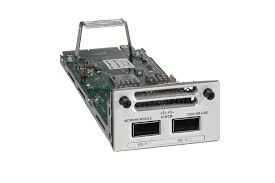
Cisco C9200-NM-2Q – Catalyst 9200 40GbE Network Module
Call for Price
-
Call for Price
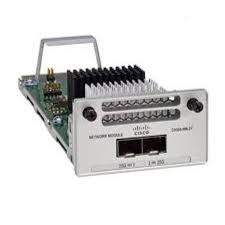
Cisco C9200-NM-2Y – Catalyst 9200 25GbE Network Module
Call for Price
-

-

Call for Price
Cisco C9200L-24P-4GE – Catalyst 9200L 24-Port PoE+ Switch
Call for Price
-

Call for Price
Cisco C9200-NM-4G – Catalyst 9200 4×1G Network Module
Call for Price
-

-
-
-
Call for Price
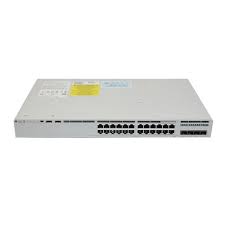
Cisco C9200L-24P-4X-E – Catalyst 9200L 24-Port PoE+ Switch
Call for Price
-
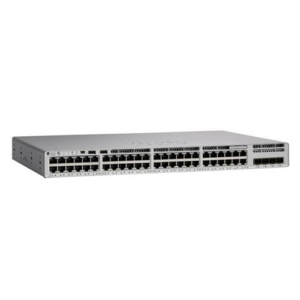
Call for Price
Cisco C9200L-24P-4G-E – Catalyst 9200L 24-Port PoE+ Switch
Call for Price
-

C9200L-48PL-4G-E
Detail :Catalyst 9200L48-port partial PoE+ 4x1G uplink Switch, Network Essentials
Condition : New Factory Sealed
Models : C9200L-48PL-4G-E - Cisco Switch Catalyst 9200
Call for Price
C9200L-48PL-4G-E
Call for Price
-

Cisco C9200CX-12T-2X2G-E – Catalyst 9200CX Compact Switch
Detail :Cisco Catalyst 9200CX 12-port 1G, 2x10G and 3x1G, data, Network Essentials
Condition : New Factory Sealed
Models : C9200CX-12T-2X2G-E - Cisco Catalyst 9200CX Series Switches
Call for Price
Cisco C9200CX-12T-2X2G-E – Catalyst 9200CX Compact Switch
Call for Price